
The War Books We Left Behind
The Overlooked, the Forgotten, and the Obscure

Friends,
Recently, I posted an essay I wrote about Karl Marlantes’ decades-long journey to publication. Karl worked on his novel, Matterhorn, for thirty-five years before he found a publisher. This week I want to explore a different dynamic.
Next month I will be teaching a class for Dead Reckoning Collective called “Dissecting the Short Story”. I’ll cover the basics such as what makes a story, a story? As well as dig deeper into how stories function and we will try to find the beating heart of a few. You can sign up here.
My friend, Karl, served in Vietnam. In 1968, he was a Rhodes Scholar studying in Oxford, but he was also a Marine Corps reservist. The war in Vietnam was ramping up and an increasing number of his classmates were returning in body bags. Karl felt that, although he did not agree with the morals of the conflict, he had a moral obligation to serve. He forfeited his scholarship and returned to the United States (he actually told me he took a detour through Africa where he let his hair grow long and saw more than a few ports along the way but that’s a story for another day), where he asked for active duty orders as a Marine Corps officer. He was immediately activated and sent to Vietnam, where he experienced intense combat. His actions in one battle earned him the Navy Cross, a distinction one step below the Medal of Honor. Soon after he returned home, he began writing a novel based on his experiences. By the time he had a first draft finished and ready to go to publishers, nobody wanted to read about Vietnam anymore. The war was over and it had been deeply unpopular for sometime. Thus began a 35-year journey to publication. There were many, many drafts. Many near successes that ended in false summits. Many moments of self-doubt. Many moments of anger. But Karl managed to pull through. His novel, Matterhorn, went on to be a massive success selling hundreds of thousands of copies and landed him on best seller lists. I’ve spoken to Karl at length about this journey several times. It’s the sort of story that does not get old, at least for me. Everyone loves an underdog. Karl’s story is exactly that. Captivating, encouraging. It could happen for you. It follows a familiar arc: obscure artist persists through trial and tribulation to come out on the other side victorious and lauded by the masses. He overcame decades worth of resistance for a real cinematic ending. But what about the others? What about all the manuscripts floating out there, unseen, stuffed away in desk drawers and boxes in attics, their unbound pages curling in the darkness? Or better yet, what about those who had the opposite experience of Karl? Those lucky few who were breakout successes only to find the heat of the limelight cooled quicker than anticipated? Or those who got their foot in the door of the notoriously cut-throat publishing world only to watch their book, the one they labored over for however long, whither upon arrival. Every year, hundreds of thousands, if not millions, of books are published and the vast majority never sell more than a couple hundred copies. In real life, the credits don’t roll. Time keeps moving
These are five books about war that I have come across during my work with LitOfWar and Patrol Base Abbate about war that I’m surprised don’t get more attention.
The Lieutenant — Andres Dubus

Known primarily as a short story writer, Dubus has exactly one published novel and I think it is one of the most underrated war novels from the 20th century. It is a war novel with no combat, not even a conventional war to frame itself around. But, if the simplest definition of war is merely a struggle between two opposing forces for a particular end, than this is a war novel of the self vs. the self.
The Lieutenant takes place in that brief period between the Korean War and the Vietnam War over several days aboard a ship conducting archaic military exercises at sea. Traditions are dying, major cultural shifts are just around the corner. After a minor infraction by one of his Marines, Lieutenant Dan Tierney launches an investigation and sets into motion a series of events that will alter the trajectory of his life as well as several others.
It has one of the most acutely rendered death scenes I have ever read. I’ve gone back to it several times. Dubus, a former Marine officer himself, nails so many of the character traits unique to the different ranks. I had many moments throughout this novel where, despite it being set half a century ago, I recognized myself and other men I served with in these pages.
Recently reissued by Godine Nonpareil (quick side note: there are tons of typos in my edition which I hope have been corrected but don’t let that distract you), this one is a solid 250 page read that is not to be missed.
Not So Quiet… — Helen Zenna Smith

This novel came to me through one of my PBA book club members. Not So Quiet… by Helen Zenna Smith (a pseudonym for Evadne Price) is arguably the most overlooked novel about World War One. Written in direct response to Erich Maria Remarque’s All Quiet on the Western Front, it follows a female ambulance driver through her confessional diary entries during the war. She and her fellow drivers spend their days transporting wounded soldiers from the front lines.
These are middle class women seeking the type of patriotic validation that drives many to serve in war. What we get as readers is a slow unravelling of the psyche as the burden of retrieving the mangled and broken bodies of soldiers from the front to the hospitals under constant shell fire takes its toll on our narrator. At times, it reminded me of Kristin Hannah’s The Women which follows women who served in Vietnam as nurses and returned home to a country unwilling to acknowledge or accept their service to the nation.
It was published in 1930 and was apparently a critical and commercial success. It sold well and spawned sequels but fell into obscurity by mid-century for reasons that are tough to pin down.
Highly recommend this one if you are into modernist techniques and epistolary style narratives.
Bloods: Black Veterans of the Vietnam War — Wallace Terry

This might be the most well known of these five. But I feel like it does not get the attention it deserves. BLOODS is an oral history project compiled by the journalist Wallace Terry. The entire book is composed of first person narratives from hundreds of hours of interviews that Terry conducted with African American troops. What’s so unique about this project is Terry presents a wide spectrum of military service for Black American men during a pivotal time in American history. Terry forgoes any type of conventional narrative arc and instead, relies on the lived experiences of his interviewees. I think I was most surprised by the level of nuance in many of these stories. There is often a fair amount of pride and camaraderie present in each section despite the racism and adversity every man experienced. Pride not necessarily in service but survival. Understandably, there is also a lot of anger and bitterness. You would be hard-pressed to find a book that is as candid and revealing as the stories in this book. Nonetheless, this one has gone out of print several times but is now available in reprint.
Sand in the Wind — Robert Roth
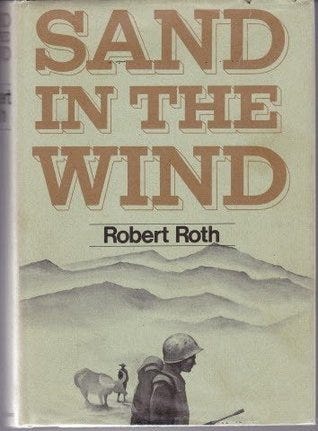
I discovered Roth through an unpublished essay titled “An Author’s Guide to Obscurity”. Karl immediately came to mind when I read Robert’s essay. Their personal writing journeys have a doppelganger-like feel. Sand in the Wind is a Vietnam War novel that follows a Marine rifle platoon through a tour of combat and loss. IT’s about all the highs and lows one can experience at war.
But whereas Karl turned his ghosts into ancestors and seems to have found peace despite experiencing intense combat and a subsequent 35-year journey to publication, Roth seems haunted by his experience in the publishing world. In this essay, he details his unlikely aspirations to become a writer with the explicit goal of writing a single, great book. That book would end up being Sand in the Wind.
What follows is a captivating, twisty journey of a Marine recently returned from war to a somewhat bitter and disillusioned author. He put everything in this essay from creative writing classrooms at Stanford to the inefficiencies of the Italian postal service, all of which play a role in leading his one great novel, Sand in the Wind, into the literary hinterlands of obscurity. One of the more interesting things to me was that both Marlantes and Roth write specifically about how when they went to write about their experience at war, the writing process was visceral and flood-like in its creation. The words seemed endless and the very act of writing had a transportive effect, bringing him back to the very moments he experienced as he was writing them. For instance, writing about a few Marines smoking grass caused him to fall into a stupor as if he were high, himself. He remarks that at one point, the manuscript was nearly a foot tall.
But that’s where the similarities in their stories end. Robert found a publisher. He received a few reviews. One great write up in the Washington Post and one short, dismissive write off in Publisher’s Weekly. But it never hit any best seller lists (initially). The rights were sold from one publisher to another and there were periods of resurgence in interest around anniversaries of the war. But then the rights got tied up in the bankruptcy of one publisher. At one point, he discovered a different publisher had bought surplus stock of the hard cover for pennies and was selling it at full price while he had lost all royalty rights due to the previous bankruptcy. Eventually, he managed to get the rights back and self-published it on Amazon where you can buy it today as well as his only other novel, Berserkley about his experiences living Berkley, California in the 1960’s. Just goes to show for all the moaning and complaining about the state of the publishing world today, it has never been easy to be an author.
Double Knot — Mac Caltrider

Full disclosure, Mac is another friend of mine. This memoir was just published last year making it the most contemporary of the five by a long shot. But it has already generated significant praise. LtCol Tom Schueman considers this the best book to come out of the GWOT. Told in a series of essays, Mac covers his time as a rifleman in the Marine Corps where he served in combat in Afghanistan through his journey home which includes time as a police officer, journalist, and high school english teacher. It’s a a slim volume at only 160 pages but it does exactly what a war memoir should do: it disrupts expectations of what a Marine should look and sound like. He does not shy away from anything, including how a young Marine makes it through endless hours of standing post with nothing to keep him company but a pack of cigarettes and his thoughts of home. If you have served in the military in the last twenty years, something in this collection will resonate with you.
I am, without a doubt, biased in the praise of this memoir (the PBA Book Club and our Return to Base Program make an appearance in the powerful final essay) but I feel like this should be on every war literature syllabus in the country.
These are just five books that come to mind. A little random in their selection, I know. But maybe I’ll do more of these in the future and organize them around certain themes or time periods.
What would you add? Post them in the comments.
Can attest to the significance of Bloods. That book messed me up. Totally changed more than a few of my viewpoints. Thanks for posting!